
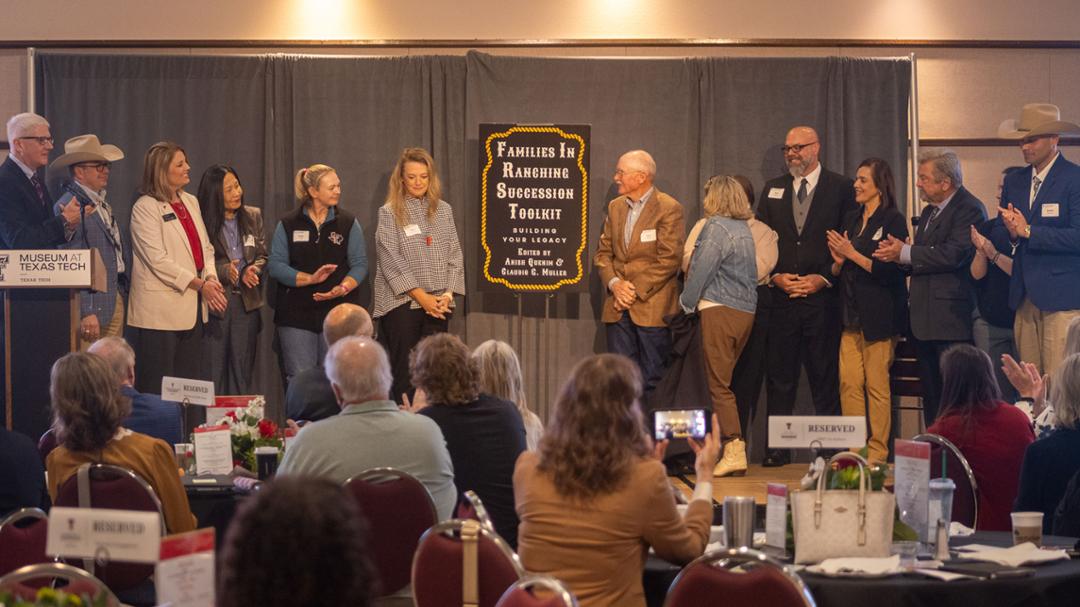

Anish Quenim coordinated the effort to connect university entities to community members and family ranchers.
Succession talks for any family business – be it the fictional Roys of the HBO show “Succession,” or the real-life examples of the Murdochs or the Guccis – can be challenging at the best of times and ruthlessly dramatic at the worst.
“Succession triggers a nerve,” said Anish Quenim, instructor and director of the Alderson & Griffin Center for Family Business & Entrepreneurship (AGCFBE) at the Jerry S. Rawls College of Business. “It’s like you’re telling the family someone’s going to die. The truth is, it’s not planning to die; it’s planning if dead.”
The same difficulties that face families in the public limelight are the ones facing ranching families across the U.S.
Texas Tech University is providing some much-needed support to those ranching families.
Quenim co-led the development of the Families in Ranching Succession Toolkit (FIRST), which officially launched Sept. 25 during a McCoy Family Speaker Series event held by the AGCFBE at the Museum at Texas Tech.
In total, current and former representation from 12 different Texas Tech entities contributed to FIRST:
- Davis College of Agricultural Sciences & Natural Resources
- College of Arts & Sciences
- Jerry S. Rawls College of Business
- College of Education
- College of Health & Human Sciences
- College of Media & Communication
- School of Law
- School of Professional Studies
- Alderson & Griffin Center for Family Business & Entrepreneurship
- Outreach & Engagement
Three community entities also contributed to the toolkit: the Ranching Heritage Association, the Lubbock County Office of Dispute Resolution and icebreaQers.
The toolkit consists of five chapters and provides readers with activities to complete as they start to tackle the complicated work of succession planning. Readers start with understanding key terms in chapter one and end with chapter five, which features the Lubbock-based Welch Cattle Company, considering milestones and how family meetings will run.
Jim Bret Campbell, executive director of the NRHC, sees FIRST as addressing a need for families that serve vital roles across several facets of the U.S.
“Ranching is a distinct way of life, as well as a business, and its culture and values of hard work, integrity, honesty and determination contribute to society as a whole,” he said. “It is critical to our economy and national security that we are able to feed ourselves and ensure that we are not dependent on foreign imports.”
The FIRST Step
The origin of FIRST stemmed from conversations Campbell had with Rod Williams, vice provost for Outreach & Engagement, and Quenim, who had previously worked in Outreach & Engagement before joining Rawls College. At the time, Campbell and his family were navigating their own succession planning and needed some guidance.
The trio realized there was a need that Texas Tech could better address: how can the university help ranching families navigate succession planning?
“The reason succession is generally a problem is this one word: communication,” Quenim said.
He speaks from experience; he’s a fourth generation of a family business and is specifically interested in helping other family businesses find their own success.

Quenim and the FIRST team eventually presented an early draft of the toolkit to their target audience: the ranching families themselves.
The reaction was not exactly warm.
“They were like, ‘What the heck are you guys talking about?’” Quenim remembered, laughing at the obviousness that comes with hindsight.
Quenim said the ranchers liked what the toolkit was trying to convey, but they had some issues with the language the writers used. They wanted something more straightforward than an academic publication.
One of the ranchers who provided feedback was Mark Kirkpatrick, who runs Stoker-Kirkpatrick Ranches with his brother and three cousins.
Kirkpatrick is a bit of a rare case. He says that ranches typically last about three generations, yet he is the sixth generation on his mother’s side and fourth on his father’s.
Succession had been on his mind for some time, so having a chance to guide FIRST in any way was an exciting opportunity for him. And despite the more academic language of that early draft, he could tell there was something special with the toolkit.
“Here’s the problem with succession planning: it’s the one thing you know you need to do, and it’s the last thing that you want to do because it requires a lot of time and work and emotional investment,” he said. “But the more you do ahead of time, the easier you make it on the next generation.”
While FIRST moved through the revision process and the language was finetuned and made more approachable, Quenim looked to support ranchers in a meaningful and long-lasting way.
The FIRST Movement
Quenim stressed that he and his team view FIRST as a starting point on the path of succession planning.
“The whole goal with broader impact is you don’t just end it with a survey or research paper. It might be that, and plus, plus, plus,” he said, raising his hand in the air and making rhythmic chopping motions. “This is a movement; it doesn’t end with me or with FIRST. Hopefully what we’ve built will be the reason why a ranch stays within a family or the family stays in the ranch.”
A two-week microcredential continuing education course for families interested in beginning succession planning was designed to complement FIRST. The toolkit’s five chapters will be repurposed into course modules with achievable goals.
Quenim said the course will first be offered in spring 2027 and is open to ranching families across the U.S.
He also spent this past summer modifying the Family Enterprise course (MGT 4377) offered through Rawls College to gain community-engaged learning (CeL) designation. He wants to work with family businesses and use their unique situations as case studies for students to directly help the families start succession planning.
Though the course is not about ranching specifically, the Kirkpatrick family is serving as this semester’s case study.
“Succession is not just for ranching families; it’s for any type of business,” Kirkpatrick said about his interest in volunteering with the CeL course. “The thing is, in agriculture and small family businesses, they’re so busy trying to make a living running the operation they can’t spend time thinking about succession planning.”
Quenim also understands the busy schedules of small family businesses and hopes the upcoming Succession Room project with the Office of Dispute Resolution for Lubbock County can help in this regard.
Set to launch in early 2027 during the next McCoy Family Speaker Series event, families will be able to book appointments through the Office of Dispute Resolution for Lubbock County to engage in mediation and succession services to create a continuity path for the family business.
Quenim hopes the toolkit can offer families an introduction to a wider range of services and assistance.
“It’s not a one and done,” he said. “It’s about hovering around in our orbit.”
And the “Big Bang” for FIRST was this past McCoy Speaker Series event.
The FIRST Launch
The morning of the McCoy Family Speaker Series on Sept. 25 featured a classic Lubbock storm. Rolling thunder served to herald the launch of FIRST, and the mood inside the museum was as electric as the lightning dancing across the sky.
Texas Tech President Lawrence Schovanec, hair and suit drenched from his walk in the storm, welcomed attendees as they settled into their seats.

“Successfully transferring these enterprises from one generation to the next is important not only to the families themselves, but also to the rural communities in which they exist and to the economies they support,” he said. “That makes today's perspectives on what you’ll hear so very important and relevant.”
Campbell led a panel session as three ranching families – Kirkpatrick, John and Bonnie Welch and Jody and Betsy Bellah – discussed their family histories, business dynamics and succession planning experiences.
And while each family shared unique perspectives, they all touched on having difficult conversations and prioritizing the family’s well-being above all else as their primary motivation.
“Succession planning is a different animal in my mind,” Kirkpatrick told the audience. “We try to come up with a plan that keeps the ranch together as long as we can, with the understanding I'm more concerned about my family members. I want them to be able to sustain a lifestyle, and at some point, if that means selling the ranch, that means selling the ranch. You just have to be realistic about it.”

After the panel discussion, attendees were invited to a lunch-and-learn session that served as a preview of the upcoming microcredential course.
But before that, Vice Provost Williams helped close the McCoy Speaker Series event and spoke about the importance of FIRST and the role of engaged scholarship at Texas Tech.
“Engagement is the front door of our university,” he said. “It's the front door that our faculty and staff and students walk through to meet with community partners. It's the front door that community partners walk through to come work with us.
“The FIRST program, from its very inception through the middle to where we are today and where we're going tomorrow, embodies everything that we want to showcase and call engagement here at Texas Tech University.”